Tuesday, September 28, 2010

Scientific Evidence for the Parting of the Red Sea


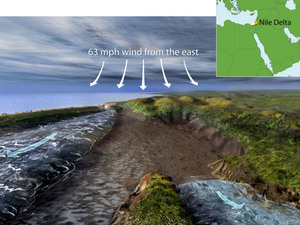
Last week it was reported by ABC, BBC, and NPR and others that a research study conducted by the U.S. National Center for Atmospheric Research (NCAR) shows how wind could have parted the Red Sea. Could this be just another whacky U.S. government research program like that depicted in The Men Who Stare At Goats? Nope. NCAR is actually a very credible research institution located in Boulder, Colorado. NCAR’s mission is to “understand the behavior of the atmosphere and related physical, biological and social systems; to support, enhance and extend the capabilities of the university community and the broader scientific community – nationally and internationally; and to foster transfer of knowledge and technology for the betterment of life on Earth.”

NCAR’s latest finding is part of a larger study that looked at how wind affects water. ABC quotes the researchers as asserting, "The simulations match fairly closely with the account in Exodus. The parting of the waters can be understood through fluid dynamics. The wind moves the water in a way that's in accordance with physical laws, creating a safe passage with water on two sides and then abruptly allowing the water to rush back in."

The parting of the Red Sea is described in both the New Testament and the Koran. As the tale goes, Moses leads the Israelites away from the pharaoh and his advancing army. When Moses reaches the Red Sea, its waters part to let Moses and his followers pass without harm then crash back down, drowning the pharaoh’s army. The water parts, “by a strong east wind all that night, and made the sea dry land, and the waters were divided."

The modeling study supports a previous observation made by Alexander Tulloch, a British general who, in 1882, saw a strong nighttime wind blow a lake almost 4-1/2 miles.

Like the theory of the Missoula Flood, this finding provides scientific evidence in support of events described in ancient religious texts, showing again that literal interpretations of religious texts aren’t necessarily at odds with science. However, not all research studies that support events in the Old Testament are created equal. Last year, Noah's Ark Ministries International, a team of evangelical Christian explorers claimed that they had found remains of Noah’s ark on top of a mountain in Turkey1. The mainstream scientific community was dubious of the finding, at best. This is an example of a group taking their religious text as literal and then going out in search of evidence to support it. This is not sound science - they aren’t willing to modify or reject their hypothesis based on the evidence they discover. Another approach is to search for scientific evidence and determine, through the scientific method, whether the evidence might support their hypothesis of a biblical event truly occurring in our distant past.

Yet, although multiple modes of evidence, a personal account and a scientific modeling study, support the hypothesis of the Red Sea parting, the scientific debate is still open. As pointed out in the NPR article, we’ll never be, “100 percent sure until someone actually finds pieces of a chariot in the area.”

Wednesday, December 16, 2009

Underwater Data Back Up Theory of Hawaii’s Origin

Courtesy of Brianne Bobo:

It is said that the Hawaiian Islands are a result of the already formed volcanoes which resulted and formed mantle plume. Mantle plume is the “upwelling hot material from deep within the earth.” This is simply a theory that has experienced several negative comments and views toward this theory. One of the factors that could influence this theory is the idea of seismetic imagining. This simply means that the seismic waves that would be traced would settle the matter. The seismic waves travel from the earthquake through the mantle that is below the island of Hawaii. Although this idea forms of seismetic imaging, it is quite hard to place this device under or around the state of Hawaii. Instead, the network of recoverable seismeters are arranged on the ocean floor. With the help from both the seismeters on the ocean floor and on the island itself, it can be said that there is a matle plume on the ocean floor right below the island of Hawaii. It was discovered that it is nearly nine hundred miles into the mantle. Another way to discover this idea of mantle plume, was the scheme of shear waves. These are waves that travel slower off the earthquake, traveling through parts of the mantle. The images that they were able to see were three-dimensional figures of the mantle. The images that were found completely support the data and ideas of the plumes that are found in the lower mantle.

Hawaii’s origin, which is partly formed from volcanoes, has formed a trail in the mantle. The volcanoes are one of the features that occur around the plate boundaries and plate tectonics. The mantle plume has an unusual amount of hot rock within the mantle itself. These mantle plumes are the cause of volcanoes, more or less called hotspots. Hotspots are one of the reasons for the development of the Hawaiian Islands. The mantle plume theory discussed has supported evidence from the Hawaiian-Emperor seamount chain, which deals with the idea of the Hawaiian Islands. They were formed through these seamount chains, which is a underwater mountainous region.

Monday, December 14, 2009

Octopuses use coconut shells as portable shelters

Courtesy of Jahnna Rymer:

title: Octopuses use coconut shells as portable shelters

by Andy Coghlan

Source : WWW.NEWSCIENTIST. COM

Octopuses have been using coconut shells as a guarding place to keep them save. This is the first attempt of tool use seen by scientists in invertebrate animals. People living in Indonesian coastal villages discard coconut shells into the sea after use. When the octopuses come across these on the seabed, they drape their bodies over and around the shells, hollow-side up, leaving their eight arms dangling over the edges. The octopuses then lift the shells by making their arms rigid, before tiptoeing away in a maneuver. When the octopuses feel threatened, they flip the half shells over themselves and hide.

Finn the scientist, who made this study, argues that the behavior qualifies as tool use for a number of reasons. “First, he states that the shells are not permanent homes like those occupied by hermit crabs, but are carried around for future use. Also, it is a costly behavior for the octopus, both in terms of energy use and in potentially making the octopuses more vulnerable to attack.” The only issue with this assumption is that, there are uncertainties about whether the octopuses have learned this behavior by observing others, or by working it out for themselves in each case. "The finding is remarkable, particularly as the octopus transports the tool for future use," says Christopher Bird of Imperial College London, who studies tool use in rooks. "But simply observing tool use in the wild doesn't necessarily mean that the animal is cognitively sophisticated, as we don't know how the behavior developed."

This is an important article because it shows how many humans are affecting animals with contamination of the planet. It is also very important because it allows us to see how marine animals are becoming used to the contaminants that are placed In the ocean. Although marine animals might seem to be adapting to the changes in the ecosystem and to the things we throw in the ocean it is not a good thing to have, even if the octopus makes a good use of it. This scientific discovery allows for both an awareness of the magnificence and intelligence of organisms as well the environmental awareness of how our actions are affecting all organisms that live on the planet.

“Underwater Data Back Up Theory of Hawaii’s Origin” by Henry Fountain, New York Times

Andrew Robertshaw

It has always been thought that the Hawaiian Islands are volcanoes that have formed as a result of a mantle plume. A mantle plume is an upwelling of hot material from deep within the earth. This idea is just a theory, which is a well tested and almost proven hypothesis. A hypothesis is only a question posed once observations have been made and data has been collected. This relates to our class discussions and assignments dealing with the scientific method.

Cecily J. Wolfe of the University of Hawaii has said that “People have been waiting for the high-resolution seismic imaging”. This means that we want to be 100% sure that our theory on the Hawaiian Island is correct, and this technology could ultimately make this a reality. It has also been said that seismometers would be a vital aspect in proving this theory due to the fact that they can show how the seismic waves from earthquakes travel through the mantle below Hawaii.

My research paper was focused on seismometers and the way work, so this directly relates to the research I did. Some of my research included ocean bottom seismometer technology, which would serve as the main technology in the Hawaiian Islands theory. This was been a problem due to the fact that putting these seismometers on the ocean floor near Hawaii was very difficult and called for advanced technology. This was eventually made possible by a network of seismometers that was put in place due to the Scripps Institution of Oceanography and the Woods Hole Oceanographic Institution.

Through the new technology of the ocean bottom seismometer system and the seismometers on the island, the data collected definitely supports the theory of a mantle plume under the Hawaiian Islands. This plume is also very deep, maxing out at least 900 miles into the earth’s mantle. By using the data from earthquakes recorded in Hawaii’s area of a 5.5 magnitude or higher, researchers were able to put together 3-D images of the mantle. Those images showed a mantle plume, and how deep it actually was.

Tourists Numbers Rise, Antarctica Tightens Shipping Control

http://www.msnbc.msn.com/id/34399680/ns/world_news-world_environment/

Over the past few years, Antarctica has been forced to tighten their shipping controls as tourist numbers have been steadily rising. Although the worldwide economy is in bad shape, there is alot of shipping that still takes place in the world and measures have been taken to ensure a reduced risk of human and environmental disaster. All vessels must now have hulls strengthened to withstand ice of the sea. Almost fifty nations signed the Antarctic Treaty, the world's main tool in managing the continent. The Polar Code will operate under a voluntary basis until it's ratified by treaty states and becomes binding. There was rules about leaving garbage or human waste behind on boats, but never really anything that said what kind of boats could use the water or what kind of fuel could be used. These are most important factors in determining the health and future vitality of the ocean. Heavy fuel oil will not longer allowed to be used in the Antarctic Ocean come 2013. This will have a major effect on the ocean as it will probably allow for more life to flourish in the ocean and the water supply will remain fresh and useful to us. The safeguards also serve the purpose to limit accidents in the region where heavy sleet, ice and fog pose major problems for ships, which could lead to accidents, which leads to a breakdown of the ship in the ocean, which leads to problems for rescuers and environmentalists alike. Tourist numbers have quadrupled in the region since ten years ago. This means alot more ships traveling in the ocean, alot more chemicals dumped into the ocean, and alot more potential garbage thrown overboard ships from careless consumers. The Treaty has been in the works for over fifty years, and it has just currently reached its forty-seventh signature.

Climate Talks Stall Briefly as Poorer Nations Walk Out

International climate negotiations were halted for several hours on Monday when dozens of developing countries, including China and India, refused to take part, saying that the world’s richer countries were not doing enough to cut their greenhouse gas emissions.
The move was mostly tactical as the climate talks entered a more serious week, by the afternoon representatives from developing countries said they were ready to turn the stakes. Still, the threat of nonparticipation from richer and poorer nations caused problems.
"The plenary was suspended," said John Hay, spokesman for the United Nations Framework Convention on Climate Change, the body sponsoring the negotiations. "The plenary was suspended. A slew of technical meetings have not taken place. Its an indication of how adamant the G-77 are about these issues."
This group of 77 nations includes most the world’s poorest countries. Not only does it include the poor nations it includes major economies such as China and India.
The Chief negotiator for India said that the group’s representatives were growing frustrated with how the conference leaders had been conducting negations.
Jake Schmidt, director of international climate programs at the Natural Resources Defense Council, said, “This is all part of the negotiating dynamic, especially as you get close to the end game.”
The industrialized countries would spend $350 million over five years — $85 million of it coming from the United States — to spread renewable and nonpolluting energy technology in developing countries.
The depth of feeling about climate issues was clear Saturday when the police and organizers estimated that 60,000 to 100,000 participants joined a long march from Christiansborg Slotsplads, or Castle Square, southward to the Bella Center.

http://www.nytimes.com/2009/12/15/science/earth/15climate.html?_r=1&ref=earth

El Alto Bolivia

New York Times article “In Bolivia, Water and Ice Tell A Story of a Changing Climate” printed on Monday December 14th 2009 speaks of the threat of global warming. The threat in El Alto Bolivia deals with melting glaciers and the receding of the Milluni reservoir. The Glaciers provide parts of Bolivia with water and electricity. Some fear with the melting and possible disappearance of the glaciers could bring an end to some communities, such as El Alto. El Alto, a “poor sister city” of La Paz, could perhaps “be the first large urban casualty of climate change”. This fear of receding glaciers threatens more than El Alto. The existent climate change occurring threaten many glaciers in the Andes. A report made by World Bank suggests that the glaciers of the Andes could be eliminated somewhere in the next twenty years. A suggestion that threatens roughly one hundred million people. The glaciers receding and what will be done to help these poor countries dealing with a major crisis of what to do about water supply is a topic for debate in Copenhagen. Poor countries are asking for economical support from the rich countries. The United Sates and the European Union have both offered to give their share of support. The European Union made a pledge to pay at least 3.5 billion dollars. However the estimated price needed to support these poor countries in danger has been projected by economists to be one hundred billion dollars if not more than that. It is countries like Bolivia that have been the voice of poor nations being threatened by potentially climate induced catastrophes that have made demands from the wealthier nations and have even suggested that the poor countries stage a walk out in Copenhagen if they do not receive enough support from the wealthy countries. Climate change is occurring more rapidly than we once may have thought. Edson Ramirez, a Bolivian glaciologist, said he had predicted that one glacier, known as Chacaltaya, would disappear by the year 2020. However the Chacaltaya disappeared this year. The effects of global warming are evident and more threatening now, and not just a threat to come in the future. A decision must be made if the wealthy countries will help places like El Alto Bolivia survive or if the money would just add to what Todd Stern, lead negotiator for the United States, calls climate debt.